The Wall by the Soap Dispenser: What a Month in a Laundromat Taught Me About Showing Up
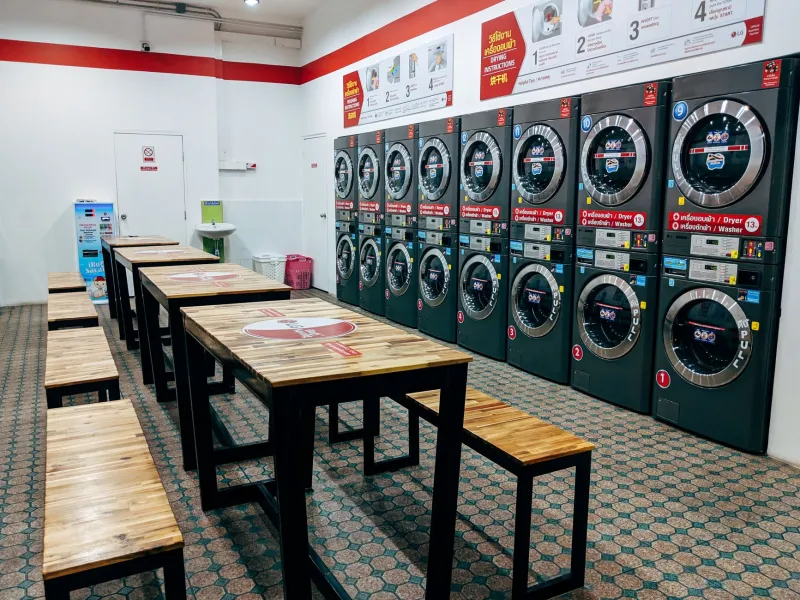
I didn’t plan to become a laundromat curator. But last October, I found myself standing in the Sudz City on the corner of my block, holding a small quilted wall hanging and a pack of Command strips, asking the owner if I could hang it by the soap dispenser. He shrugged. 'As long as it doesn’t scare the kids,' he said. That was my entire curatorial statement.
The Pitch
Here’s the thing: I’d spent the better part of two years trying to get my work into galleries. I’d submitted to juried shows, paid entry fees, mailed slides, and once drove three hours to hand-deliver a portfolio to a gallery director who looked at it for eleven seconds. I’m not bitter. I’m just tired. Tired of the white cube, the guest book, the wine in plastic cups, the polite nods from people who are there because their friend has a piece in the back room.
So when I finished this little quilt—fourteen by eighteen inches, made from scraps of my grandmother’s old curtains and a few fat quarters I bought on sale—I didn’t know what to do with it. It was too small for a gallery, too personal for a craft fair, too weird for my living room wall (my partner has opinions). And then I walked past Sudz City and saw that empty wall between the change machine and the folding table.
I asked Luis, the owner, if I could hang it for a month. He said yes before I finished the sentence. 'People need something to look at besides the dryers,' he said. That’s a better artist statement than anything I’ve written.
The Viewing Hours
The laundromat is open seven days a week, six in the morning to eleven at night. My 'show' had no opening reception. No closing party. No artist talk. Just fluorescent lights, the smell of dryer sheets, and a rotating cast of characters who were there because their socks were wet.
I hung the quilt on a Tuesday afternoon. By Wednesday, someone had already touched it. I know because there was a small smudge near the bottom corner—probably from a kid with sticky fingers. I chose to consider it a review.
For a month, I stopped by at random times. Not to check on the piece, exactly. More to watch. I’d sit on the plastic chair by the vending machine and pretend to scroll through my phone. Here’s what I saw:
- A woman in scrubs waited for her scrubs to dry, looked at the quilt, and said out loud, 'My grandma had a quilt like that.' She didn’t say it to me. She said it to the air.
- A teenager took a photo of it for her Instagram story. I don’t know what she captioned it. I’m afraid to ask.
- A toddler tried to pull it off the wall. His mother stopped him and said, 'Look with your eyes, not your hands.' He looked with his eyes for about three seconds.
- An older man named Frank, who I later learned comes every Tuesday, told me the colors reminded him of his mother’s kitchen. 'She had a tablecloth that exact shade of yellow,' he said. I told him I made it from curtains. He nodded like that made perfect sense.
- A guy in a construction vest asked if it was for sale. I said no. He said, 'Good. You shouldn’t sell your art in a laundromat.' I’m still not sure if that was a compliment or a warning.
The piece got dusty. A corner curled up. Someone spilled a little detergent near the bottom and didn’t wipe it up. I left it. It felt honest.
The Feedback Loop
In a gallery, people look at art for an average of six seconds. I read that somewhere. In the laundromat, people looked at my quilt for as long as it took to fold a fitted sheet—which is to say, a long time. They had nothing else to do. They weren’t there to see art. They were there to do laundry. That meant any reaction they had was real. Not performative. Not polite. Just real.
One woman asked me if I was the artist. I said yes. She said, 'I don’t get it.' I asked what she didn’t get. She said, 'Why here?' I told her I wanted to see what would happen. She nodded and said, 'Well, I saw it. So I guess something happened.'
That’s the whole thing, isn’t it? Something happened. Not a sale, not a review, not a follower. Just a moment between a person and a thing I made. No admission fee. No dress code. No wine.
What I Took Down
When the month was over, I took the quilt down. It had a smudge, a curled corner, and a faint smell of lavender dryer sheets. I hung it back up in my studio, but it looked different. Less precious. More like it had a life.
I’m not saying galleries are bad. I’m saying there are other rooms. Rooms with coin slots and folding tables and fluorescent lights that buzz. Rooms where people aren’t afraid to say 'I don’t get it' or 'my grandma had one like that.' Rooms where your art has to compete with the spin cycle, and somehow that makes it stronger.
Luis asked if I wanted to hang another piece next month. I said yes. I’m thinking about a series of small quilts, one for each wall. Maybe I’ll call it 'The Sudz City Sessions.' No opening reception. No price list. Just a wall by the soap dispenser and whoever happens to walk by.
That’s the best gallery I’ve ever shown in.