The Market I Turned Down and the November That Opened Up

The application landed in my inbox in early September 2026, same as it does every year. It was the big one: the holiday market that fills a convention hall, draws a crowd that starts lining up before the doors open, and looks excellent in photos. For years I had said yes without thinking. This year I read the whole thing, got to the booth fee, and felt something I had not felt before: absolutely no desire to be there.
I sat with that for a week. Then I sent the email. Thanks so much, but I am sitting this one out. I closed the laptop and immediately wanted to take it back.
The yes reflex is real
For a long time, holiday market season felt like a sales emergency. Every weekend from late October through mid-December was a booth, a backup booth, a waitlist, a maybe. I would stack up applications like canned goods. If I was not selling somewhere, I assumed I was losing ground. The math never really supported it, but the fear did.
The fear says: if you are not visible, you are disappearing. The fear says: everyone else will be there. The fear says: what if this is the year the whole thing takes off, and you miss it because you stayed home?
So I said yes. I said yes to markets that did not fit my work, to booth fees that ate the profit, to six-hour drives for four hours of foot traffic. I said yes until November became a blur of folding tables and card readers and half-eaten granola bars.
What an empty Saturday actually feels like
The first weekend of the big market came and went without me. I woke up at the same early hour out of habit, made coffee, and sat in the studio with no checklist. No inventory to count. No tent to wrestle into the car. No emergency run for tissue paper and tape.
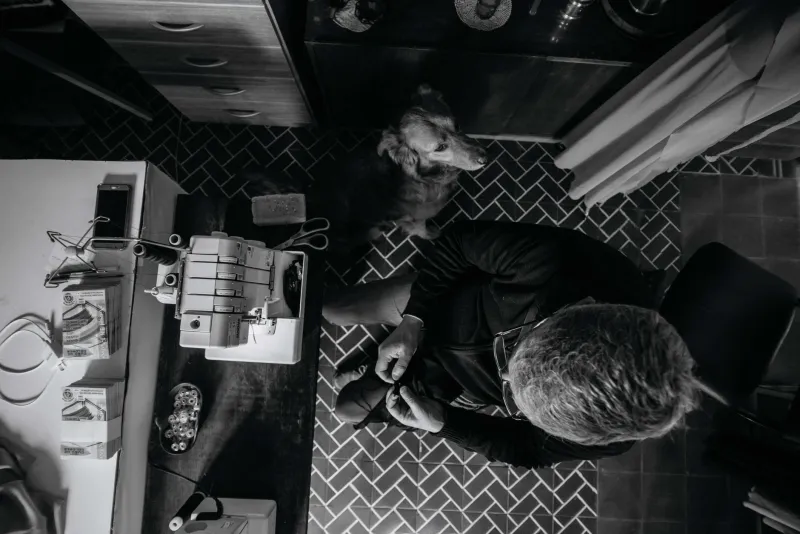
I scrolled through the market photos for about eight minutes. Everyone looked busy and happy in that specific craft-fair way. I felt a little weird. Then I closed the app and did something I had not done in months: I repaired a seam on a project that was never going to be for sale. It took an hour. Nobody clapped. It was great.
That afternoon I cleaned one shelf in the studio. Not a big purge, not a content-worthy reset. Just a shelf. I found three spools of thread I forgot I had and a note from a friend I meant to answer in April. The quiet was not empty. It was just quiet.
The audit I should have done years ago
Here is the embarrassing part: I had never actually audited my market calendar. I treated every application like an obligation and every acceptance like a compliment. I never asked what the whole thing cost me in time, money, and attention.
So I did it. I made a simple list of the markets I had done in recent years and wrote down four things for each one:
- The all-in cost, not just the booth fee.
- The number of hours from prep to teardown.
- The money I actually made after expenses.
- The people or connections that came out of it.
A few markets looked great on paper and terrible in real life. One looked like a loss but had led to two custom orders and a workshop invitation. Another looked profitable until I counted the fourteen hours of inventory prep and the two days I lost recovering afterward. The numbers were not the whole story, but they were a story I had been avoiding.
Guilt is not a business metric
The guilt showed up around week two. I felt lazy. I felt like I was letting people down, even though nobody had asked me to be there. I kept opening my email like the market police might send a citation.
But guilt is not a business metric. It is just a feeling, usually one borrowed from somebody else's expectations. I had spent years confusing visibility with value. If I was not at a market, I thought I was not working. But working is not the same as showing up somewhere to be seen working.
Saying no did not mean I was anti-market. I still like markets. I like watching somebody pick up a piece and turn it over. I like the weird conversations you only have when you are standing behind a table for six hours. I just did not need every market to prove I was serious.
What I am doing with the weekends instead
I am not pretending I turned my empty November into a productivity miracle. I did not write a book or launch a product line. I finished a commission I had been avoiding. I took a Saturday to reorganize my thread. I went to a small local pop-up as a shopper, which is a completely different experience when you are not calculating booth traffic.
I also applied to two smaller markets for December, not five. I picked ones where the organizers actually know the vendors and the crowds come looking for handmade work. If I get in, great. If I do not, I will have a quiet weekend and a clean shelf.
A short, non-preachy checklist for your next market decision
If you are staring at one more application this season, here is the simplest version of what helped me:
- Write down the all-in cost, including travel, packaging, help, and the inventory you will make whether or not it sells.
- Count the hours honestly. Prep, drive, set up, sell, tear down, recover.
- Name what you will not do if you say yes. That is the real price.
- Ask whether the audience is actually your audience, or just a crowd.
- Give yourself a deadline to decide, then decide. Do not let the application sit there making you feel bad.
You do not have to turn down the biggest market on your calendar. Maybe it is exactly right for you this year. But you are allowed to check. You are allowed to notice that a yes to one more booth is a no to something else.
November can be quiet. The market will go on without me, and it will go on without you. That is not a tragedy. That is just a calendar with some breathing room in it.