The Tablecloth Went to Ohio and Came Back Knowing Things
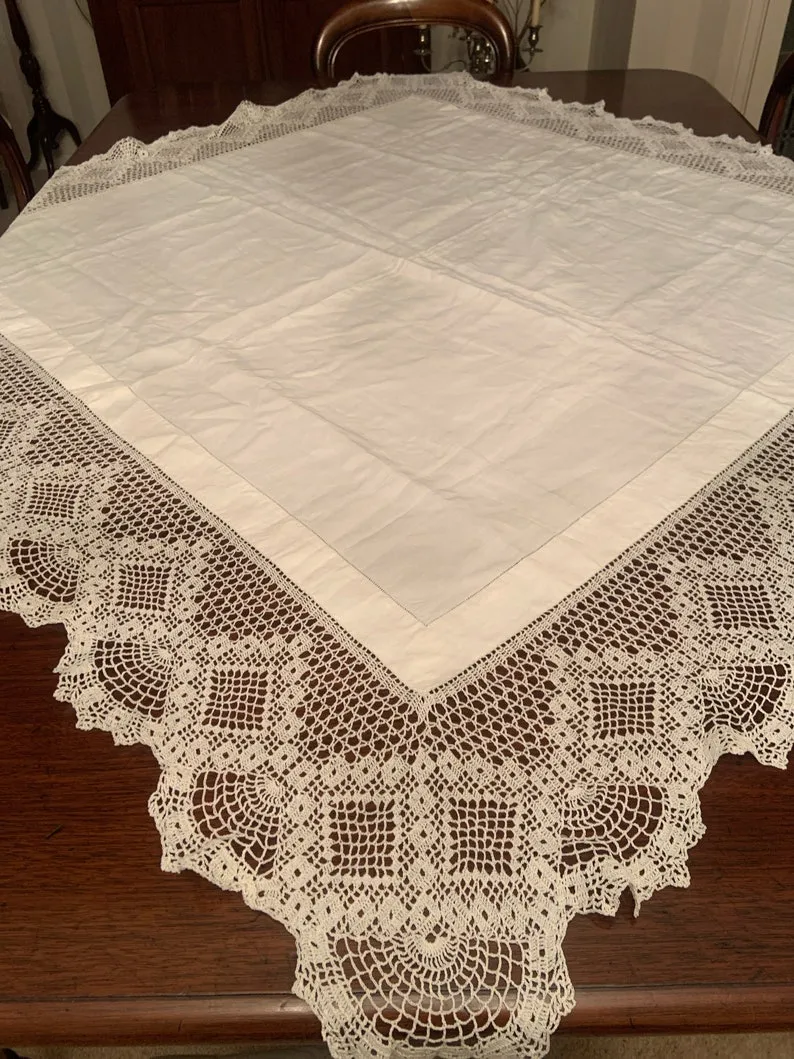
Photo: vintage linen tablecloth with crocheted edging on wooden table hands mending needle thread, via i.etsystatic.com
The tablecloth sat in my cedar chest for eleven years. Every time I opened the chest — and I opened it more than I'd like to admit, mostly when I needed to feel something — I'd lift the cloth, run my thumb along the hem, and close the chest again.
It was my grandmother's. Cream-colored linen, crocheted edging, a tea stain near one corner that she never bothered to treat because, according to my mother, "she figured a stain meant the table was used." It had been folded, unwashed, in the same tissue paper since 2009 when my grandmother's house in Tucson was cleared out.
I don't sew. Let's just establish that. I write about people who make things, which is its own kind of impostor syndrome. And every year the cloth got a little more yellow, a little more brittle at the folds. Every year I did nothing, because doing nothing felt safer than ruining it.
The Math of Doing Nothing
Here's the thing about heirlooms: we treat preservation as passivity. Keep it folded, keep it dark, keep it untouched, and you've kept it safe. But linen doesn't work that way. Fabric that never moves deteriorates along its creases. The folds themselves were becoming the damage.
So doing nothing was doing something. It just didn't feel like it.
I found the mender through an Instagram post, the way you find everything now. A woman in Ohio — I'll call her D., because her business name is her actual name and I didn't ask permission to put it in an essay — who repairs quilts, wedding dresses, and "the things people are scared to ship." Her feed is mostly before-and-afters, but occasionally she posts the notes that come with packages. "This was my mother's. Please be careful." "No rush, just please don't give up on it."
I read those notes for twenty minutes before I emailed her.
Trusting a Stranger With the Unrepeatable
There's a specific anxiety to mailing something irreplaceable. Not expensive — irreplaceable. The difference matters. I've shipped laptops, cameras, a car bumper once. All of those had dollar values and insurance. The tablecloth had a value of roughly zero and a weight of roughly everything.
I wrapped it in a clean cotton sheet, then tissue, then put it in a box with a note of my own. Mine said, embarrassingly, "Please don't feel pressure. If it can't be saved, that's okay." Which was a lie. It was not okay. But I wrote it anyway, because I wanted to give her permission to fail, and I realized later what I was actually doing: I was trying to protect myself from disappointment by pre-forgiving it.
D. emailed back within a day. She asked questions nobody had ever asked me about the cloth. How was it stored? Had it been washed with detergent or just water? Did I want the stain kept or treated? Kept, I said. The stain is the point.
Then she told me what she saw: the crocheted edging was intact but the anchoring stitches had failed along about eight inches. The yellowing was reversible. And — this part got me — she could tell from the thread count and the weave that it was likely machine-made in the 1940s or '50s, but the edging was done by hand, probably by more than one person, because the tension shifts midway through.
Two people made this tablecloth. Maybe my grandmother was one of them. Maybe not. I will now never know, and I find that I love the not-knowing.
The Quiet Economy of Fixers
While the cloth was in Ohio, I got curious about D.'s world. There are more of her than I expected — the visible tailors and the invisible ones. The quilt restorer in Vermont with a nine-month waitlist. The denim repair guy in Los Angeles charging more per repair than the jeans cost new, with a backlog anyway. The wedding-dress preservationist in Georgia whose entire business is other people's most photographed day.
None of these people went viral. None of them have courses. They have waitlists, which is better. A waitlist is trust compounding.
What struck me is how much of their work is emotional labor disguised as stitching. D. told me she budgets conversation time into every job. People don't just send cloth; they send context. "This is the quilt my dad used when he came home from the hospital." "My mom made this before the dementia got bad." The repair is the transaction. The story is the reason.
We talk a lot about maker culture in this space — the joy of the handmade, the pride of the personal. We talk much less about the other half of it: the willingness to let someone else's hands into the middle of your story. Making is only half the craft. Trusting is the rest, and almost nobody teaches it.
The Return
The box came back on a Tuesday in October. Inside: the tablecloth, pressed, the yellowing lifted, the edging re-anchored with tiny stitches in matching thread. The tea stain remained, softened, like it had agreed to stay on good behavior.
And underneath it, a repair receipt, handwritten. Not an invoice — a receipt. It listed the work, the materials, the hours. Then a line at the bottom: "The edging is lovely. Whoever held the second section had a looser hand, but they were consistent. That's harder than it sounds."
I have thought about that sentence more than I think about most things. Whoever held the second section. A looser hand, but consistent. It reads like a description of about half the people I admire.
The cloth is on my table now. Not folded in a chest — on the table, under plates, getting stained again. That was the actual lesson, I think. D. didn't just fix the linen. She made it usable, and a usable heirloom is a living one. The safest thing I could have done was keep it folded. The best thing I did was put it in the mail.
If you've got something in a chest — a quilt, a dress, a cloth with two makers' hands in it — the menders are out there. They're patient, they're underpaid for what they actually carry, and they will ask you better questions about your own family than you ever thought to ask.
Send it. The worst case is you get it back the same. The best case is you get it back with a story you didn't expect.