One Object They Almost Kept: Notes From a Summer of Garage Sale Portraits

Photo: Studio publicity shot., Public domain, via Wikimedia Commons
Somewhere between a rummage sale in Sacramento and a swap meet outside Fresno, I started noticing a pattern: nearly every table at every sale had one item that was priced weird. Too high. Or marked NFS — not for sale — with a strip of masking tape and a Sharpie. Or just quietly moved to the back of the folding table whenever someone browsed too close.
That item was the whole project.
The Setup
I called it the Garage Sale Portrait Project, which is a fancy name for a simple thing. I'd show up early, ask the person running the sale if I could set up a chair nearby, and offer them a deal: I'd take a portrait of them holding one object they almost didn't sell, and in exchange they'd tell me the story behind it. Five minutes. No payment. Most people said yes faster than I expected.
Over one summer I photographed fifty people. A retired mail carrier in Arizona holding a dented lunchbox. A woman in her twenties clutching a Prom dress from a Goodwill bin she'd bought to deconstruct — and then never could. A man selling his late wife's craft room, table by table, who kept one jar of mismatched buttons on his dashboard for a month before deciding it went on the table after all.
What People Actually Said
Here's what surprised me: almost nobody talked about money. In a setting that is, definitionally, about converting objects into cash, the stories were all about time. A fishing lure a father tied. A ceramic owl from a sister's first apartment. A 1970s polyester blouse that a seamstress kept because, in her words, "the collar construction is a masterclass and I still haven't figured it out."
That blouse got me. This woman had been sewing for forty years, and she was holding onto a thrift-store shirt because it was still teaching her something. That's not sentimentality. That's a curriculum.
The second thing I noticed: people apologized. Constantly. "It's silly." "It's just a thing." "You probably think I'm crazy." Nobody ever apologized for the expensive stuff or the nice stuff. Only the objects that didn't translate — the ones whose value was invisible to anyone who hadn't lived inside the story.
The Emotional Economy of a Card Table
We talk about secondhand goods like they're a bargain category. Estate sale culture, swap meets, Facebook Marketplace — the whole apparatus treats objects as inventory moving from one life to the next. But standing at those tables week after week, I started to see it differently. Every sale is a negotiation not just between buyer and seller, but between two versions of a person: the one who needs the space, and the one who remembers why the space got full in the first place.
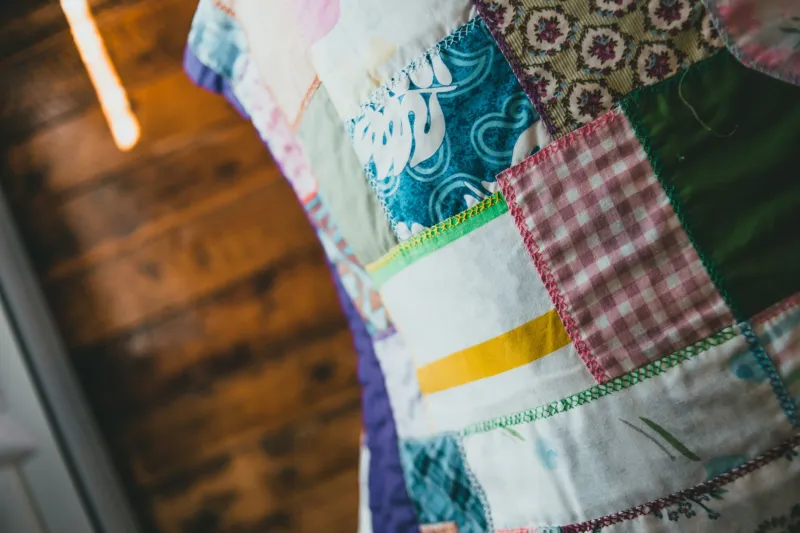
The objects that almost didn't sell were never the valuable ones. They were the unfinished ones. The half-quilted top. The tools of a hobby someone meant to return to. The material for a project that was really a promise to a future self.
If you make things, you already know this feeling. Your studio is full of objects in negotiation with themselves.
Three Portraits That Stayed With Me
The lunchbox. Ray, 71, retired postal worker. Kept a scratched metal lunchbox from his first route in 1978. Sold it to me for a dollar after the portrait. "It's time," he said. I have it on my shelf now. I'm not sure I deserved it.
The buttons. The widower with the jar. He didn't sell it in the end. He put it back in his truck, told me his wife had a system for the buttons that he never learned, and driving home with the jar meant one more day of her handwriting on the lid.
The prom dress. Dani, 26, textile artist. Bought it to cut up for fabric, kept it whole for two years. She finally sold it that morning — to a teenager going to prom. "That's the only ending I'd have accepted," she told me. Then she cried in her car, happily, she insisted.
Your Turn
Here's where you come in. I want to keep this going, but I can't crash every garage sale in America by myself. Send me the story of your unpartable object — the thing you priced, hesitated over, and pulled back off the table. A photo helps but isn't required. What is it, who gave it to you or where did it find you, and why is it still in your life?
I'll be running a selection of submissions here on the site over the coming months, and if this project teaches me anything else, I suspect it'll be the same lesson the summer already taught me: the things we can't throw away are rarely about the things at all. They're about the people we were when the objects came to us — and the people we're still hoping to become.
Drop your story in the comments or shoot it over through the contact page. The folding chair is packed. The camera battery is charged. Let's see what else America can't let go of.