Four Hundred Dollars and a Full-Blown Identity Crisis: The Day I Priced Like a Professional
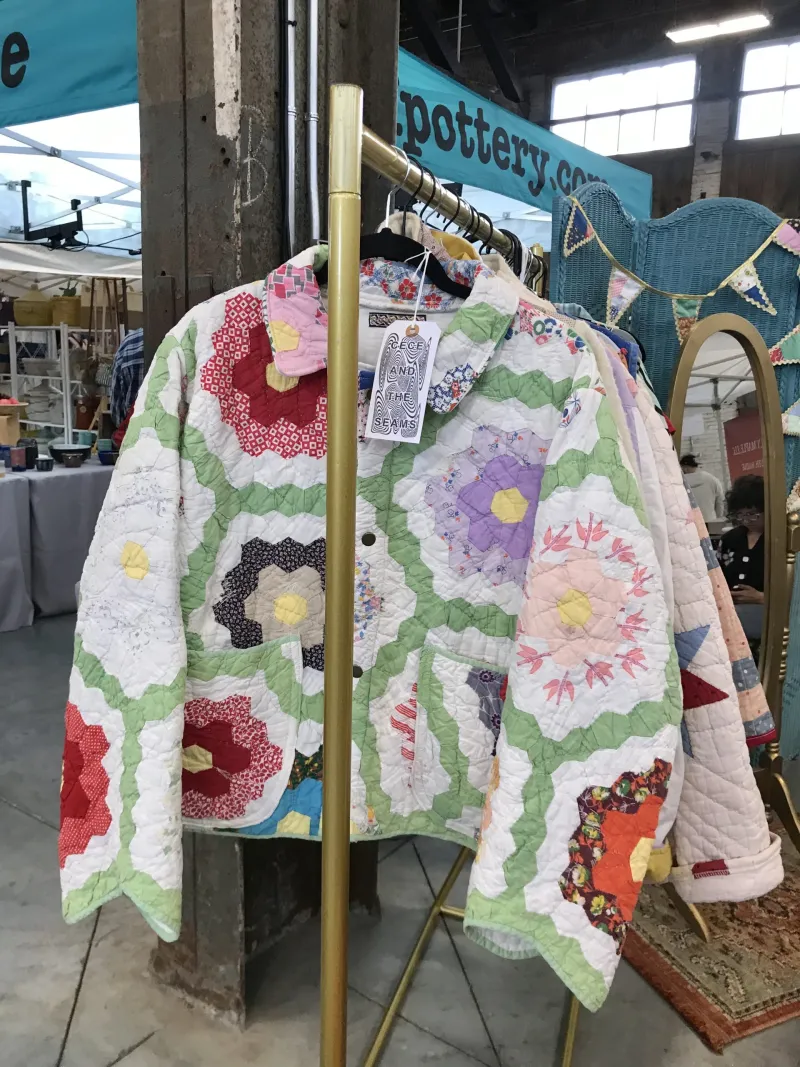
Photo: handmade quilted jacket hanging on rack at craft market booth with price tag, via i0.wp.com
There's a specific kind of nausea that comes from writing a number on a tag and sticking it to something you made with your own hands. I felt it at a Saturday market in Austin, standing behind a card table with a quilted jacket I'd spent eleven weeks on, holding a Sharpie over a little kraft paper sign like it was a live grenade.
The jacket was priced at $400. Every fiber of my being screamed that it should be $95.
The Voice in My Head Had a Lot of Opinions
Here's what that internal monologue sounded like, in case you've hosted the same show: Nobody's going to pay that. You learned this technique off YouTube. There's a woman two booths down selling machine-made totes for $30. Who do you think you are?
That last question is the whole disease. "Who am I to charge that" isn't really about the price. It's about believing your time, your skill, and your taste only count once somebody else — some imagined gatekeeper — signs off on them. Underpricing feels humble, but it's actually a creative block wearing a nice cardigan. When you charge $95 for eleven weeks of work, you're not being modest. You're scheduling your own burnout.
I hung the $400 tag because a friend had threatened me. Genuinely threatened me, over tacos, with something like: "If I see that jacket priced under three hundred, I'm telling everyone you made it in a sweatshop. Your own sweatshop. You're the sweatshop."
She was right. I'd been the sweatshop for years.
What Actually Happened at the Booth
I want to report a dramatic story: a collector swooped in, wept, wired money from Zurich. Nope. What happened was weirder and better.
People picked the jacket up. They looked at the tag. And then — this is the part that broke my brain — they didn't flinch. A woman tried it on, asked about the batting, and said, "That's fair for hand-quilting," and walked away to think about it. A guy asked if I took payment plans. Two different people assumed there was a more expensive version somewhere and asked to see it.
Nobody laughed. Nobody lectured me. The humiliation I'd rehearsed for three days straight simply didn't show up to the market.
The jacket sold near closing time, to a customer who asked if I had a mailing list. The $95 version of me would have made exactly $95 and a story about how "the market just doesn't support real prices." Instead I made $400 and a mailing list.
Then came the friends. A couple of them said, quietly, that the price seemed high. One asked if I "felt comfortable" charging that. I'd like to note that nobody asks a plumber if they feel comfortable charging $400 to fix a pipe. But that's a whole other article.
The Framework That Ended the Guesswork
After that Saturday, I stopped pricing by vibe and started pricing by math. If you're stuck charging what feels safe, here's the system that got me unstuck:
1. Track your hours honestly. Not aspirational hours — actual ones. Eleven weeks of evenings was about 60 hours. Lie to yourself here and everything downstream is fiction.
2. Set a real hourly rate, then double it. Pick a number you'd quit your day job for, not a number that sounds "reasonable." If $25/hour feels right, price at $50/hour. The doubling covers materials, mistakes, failed pieces, and the months nobody buys anything.
3. Add materials at retail, not cost. If you'd have to rebuy supplies at full price tomorrow, that's what they're worth.
4. Compare your work to what's around you — then don't copy it. Know your market, sure, but remember that the artist underpricing two booths down is subsidizing their work with a salary you don't know about. Their tag is not your truth.
5. Run the number against your gut — once. If the math says $400 and your gut says $180, the gap isn't a pricing problem. It's a self-worth problem, and no tag adjustment will fix it.
The Part Nobody Warns Me About
Here's what surprised me most: raising my prices didn't shrink my audience. It filtered it. The people who stick around treat the work — and by extension, me — with more care. Fewer requests for "a quick little thing, doesn't have to be fancy." Fewer friends asking for discounts. More people who hang my work in homes where guests ask about it.
Underpricing tells the world your work is an impulse buy. Fair pricing tells them it's an investment. The market, it turns out, mostly believes whatever tag you hang.
So if you're sitting on a Sharpie moment of your own — hovering over a number that scares you a little — consider that the fear might be the signal. Not a warning to shrink the price. A sign that you're finally taking yourself seriously enough to be paid like it.
Hang the tag. Let the number do its job while you get back to the actual work.