The Cardboard Box of Shame: Why I Spent a Whole Saturday Reading My Own Failures
Photo: Franz van Duns, CC BY-SA 4.0, via Wikimedia Commons
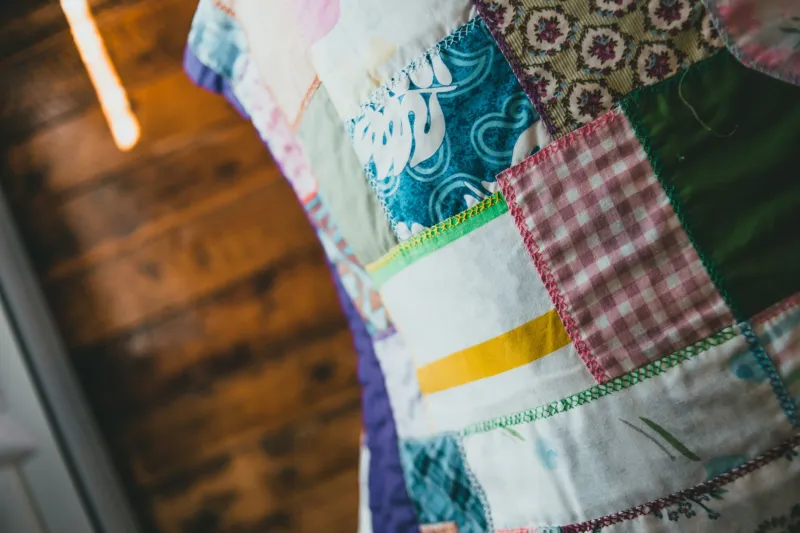
There's a box in the back of my closet that I have not opened in roughly six years. It's an Amazon box, because of course it is, with "MISC — DO NOT TOSS" scrawled on the side in Sharpie that has since faded to a ghostly gray. Inside: my worst work. The lumpy first bag I ever sewed. A quilt top that stops abruptly at lap size, abandoned mid-border. Three journals from a ceramics phase nobody asked about. A scarf, felted by accident in the wash, that I gave to my sister anyway because it was December 24th and I had nothing else.
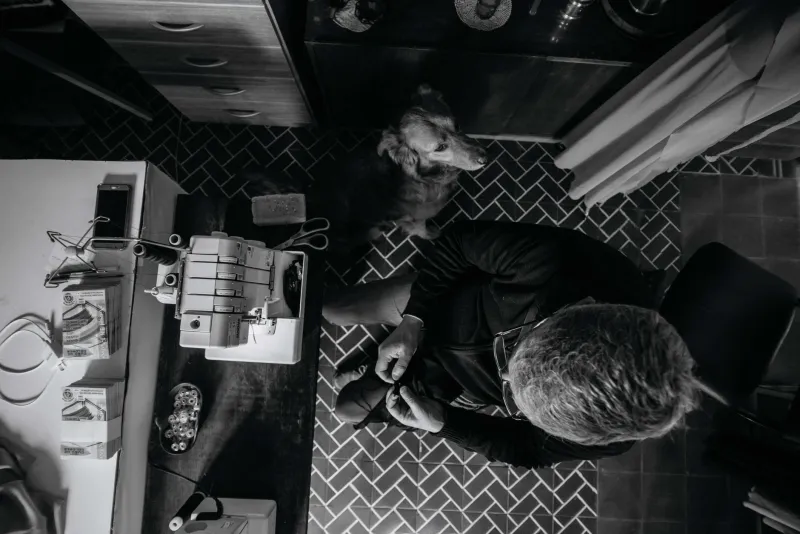
I call it the box of shame. Last Saturday, on a whim and maybe a little avoidance of an actual deadline, I pulled it out, dumped it on the bedroom floor, and spent four hours going through it like an archaeologist who was also the lost civilization.
This Wasn't a Nostalgia Trip. It Was an Audit.
Here's the thing I didn't expect: I didn't feel embarrassed. I felt like a detective.
Because once you get past the initial oh no, the tension on that topstitch, a funny thing happens. You stop seeing the objects and start seeing the decisions. Every lumpy seam, every wonky color choice, every project that dies halfway through — each one is a record of a habit. And habits, unlike objects, can be traced.
So I grabbed a legal pad and started taking notes. Which habits had died? Which ones stuck around?
The died list was long and satisfying. I used to buy fabric for projects I hadn't designed yet — the stash grew faster than the output. Gone. I used to skip the swatch, skip the muslin, skip every boring step between idea and finished thing. Gone, mostly. I used to abandon a project the moment it stopped being exciting, which explains why the quilt top just... stops.
The stuck list was shorter, and honestly more interesting. I still overthink color. I still finish seams badly when I'm in a hurry. I still, apparently, love making things for people even when the thing goes sideways — see: felted scarf, sister, Christmas.
Your Best Work Can't Teach You This
Here's my actual argument, and I'll die on this hill: keeping your bad work is the most underrated professional development strategy a creative person has access to. It's free. It's private. And unlike your best work, it doesn't flatter you.
Your portfolio shows you what you can do on a good day. Your failure archive shows you what you do by default — the shortcuts, the tells, the patterns you fall into when nobody's watching. That's the stuff worth knowing.
Think about how athletes review game tape. They don't study the highlights reel. They study the turnovers. Same energy, cardboard box edition.
And there's a secondary benefit nobody talks about: the box recalibrates your relationship with progress. Six years is long enough that improvement becomes visible. I could see the distance between the lumpy bag and what I made last month. On a Tuesday in February, when everything I touch looks like garbage and the algorithm is full of seventeen-year-olds with perfect stitch length, that's not nothing. That's evidence.
How to Actually Do This (Without Spiraling)
If you want to run your own audit, a few ground rules from someone who just did it:
Give yourself a time limit. Four hours was right. Any longer and it turns into either a pity party or a rummage sale. Set a timer, dump the box, take notes, pack it back up.
Bring a notebook, not a trash bag. The instinct is to purge. Resist it for one session. You can't diagnose what you've thrown away.
Ask two questions per object: What habit does this represent? And is that habit dead or alive? That's it. No grading, no ranking, no "what was I thinking."
Keep the worst piece. Not the best of the bad — the worst. Mine is the bag. It lives in the box, and the box lives in the closet, and twice a year or so I look at it and remember that every skill I have was built on top of that bag.
The Box Goes Back in the Closet
By Sunday night the box was taped shut again, Sharpie refreshed, legal pad full. Nothing got thrown away. Nothing got posted anywhere. It was just me, my floor, and six years of evidence.
I keep thinking about how we archive everything now — every post, every draft, every cloud-synced file — but almost never on purpose, and almost never our failures. The box of shame might be the only honest archive most of us keep. It's certainly the only one that tells the truth about how we actually work.
Open yours. Take notes. Then tape it back up and get back to making the thing you're avoiding. Worked for me.